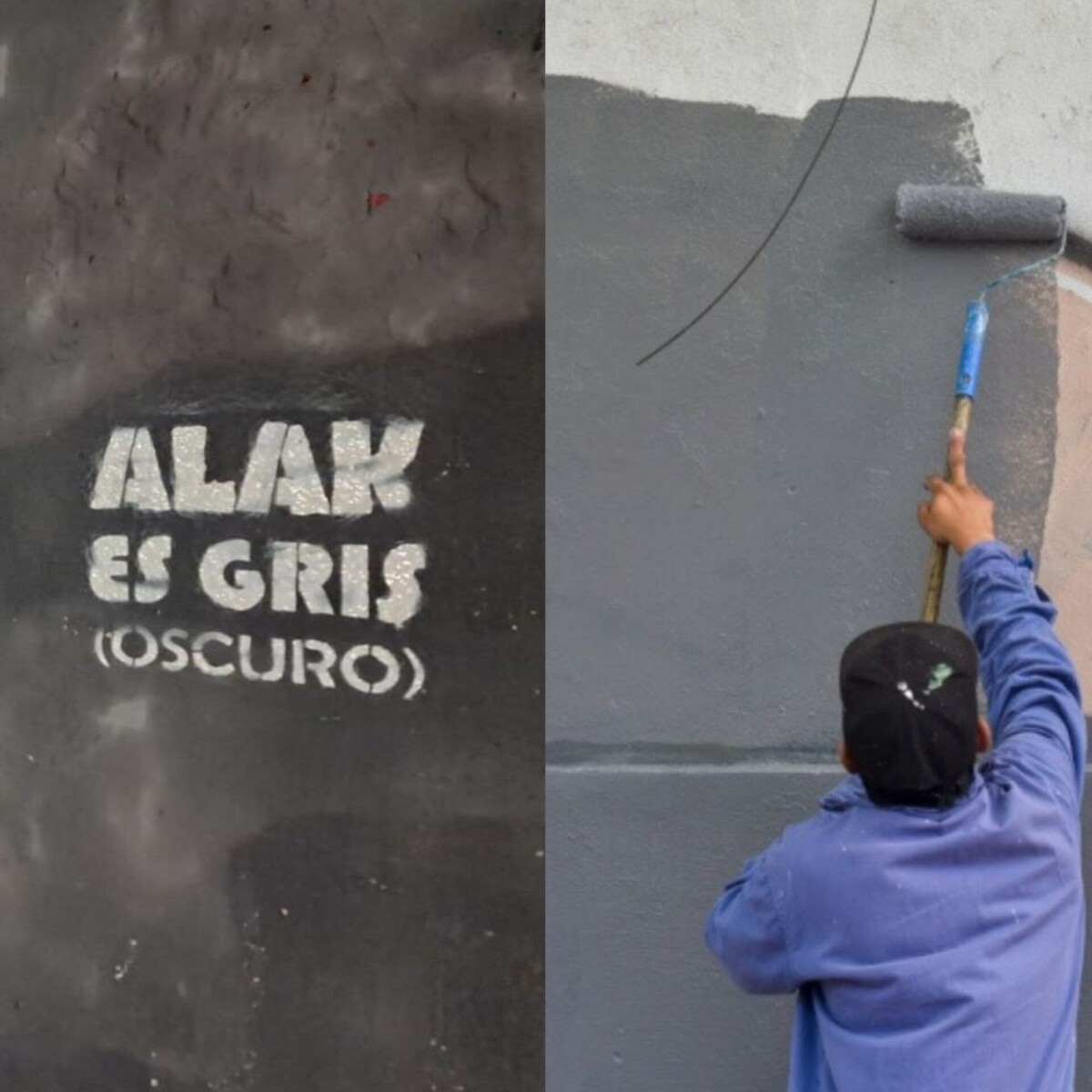
The Municipality of La Plata is repeatedly and persistently attempting to cover up any graffitied or neglected facades with grey paint. These ways of inhabiting public space end up "disfiguring" the city.
Across the walls of this model city, the capital of urban hygiene, a symbol of order, planning, and cleanliness, a message has recently appeared. Replicated throughout the city, the stencil synthesizes the rejection of the municipal initiative, framed within a public works plan criticized by several social organizations and artistic collectives as gentrifying and exclusionary. It is a series of "sanitation" measures for the urban fabric, loaded with the most expulsive residues of the hygienist paradigm on which the Buenos Aires capital was founded. This includes not only covering the city in grey but also evicting street vendors, dismantling fairs, criminalizing street art, and tearing apart a whole network of activities that constitute forms of the popular economy in a context of economic emergency and social crisis.
The intervention holds Julio Alak, the mayor of La Plata, responsible for the "restoration" program that has already buried works in homage to Nora Cortiñas, a founding mother of the Plaza de Mayo, Julio López, a disappeared person during the last military dictatorship who disappeared again under democracy, and murals that interrupt the neat and comfortable experience of the planned city, such as that of a boy sleeping on the street, painted precisely in a hole where people usually take shelter from the elements.
At the heart of this ash-colored steamroller lies the obsessive impulse to build a functional metropolis, a fluid space, sanded down of any roughness that might generate friction in the circulation of the citizen fantasized about by economic power: alienated, depoliticized, and, of course, with money in their account to stimulate local commerce; a neighbor regulated by a text that offers them a city designed exclusively as a surface for consumption.
From those managing the Public Space Recovery Plan and promoting the "Clean City" program, the measures—relocation of street vending, urban remodeling without citizen participation, persecution of informal forms of labor—are presented as justified by the "value of order and social progress." However, gentrification as a key reading unveils their interested character in favor of real estate speculation and the institutionalization of exclusion.
The political mural, the kind that gets creative on the street, or the kid sleeping on the sidewalk become, from this perspective, appropriations of space that profane the canonical uses of the urban environment and represent an obstacle to the valorization of land and property.
Beneath the grey that attempts to erase the traces of a living city, memories stir, insist, and are read. "Alak is dark grey," a piece of graffiti against the advance of the "Clean City" Program, which since its launch at the end of 2024, has covered dozens of murals, posters, stickers, and public interventions under the pretext of preserving the urban layout.
It becomes merchandise. Beneath the grey that uniforms the streets of La Plata, memories that insist, marks of the dispute for a common space, and signs of the desire for another world stir.
"A city without desire," it says, "there people only think about what they already know." A common denominator weaves them together and gives them cohesion even in their differences: the majority pursues the enhancement of the Platense landscape at the cost of the collectives and people whose economic and cultural practices do not adjust to the desirable and expected modes conceived by the normalizing and punitive imaginary that is well summarized by the slogan of the "Clean City."
In an urban enclave with a historical tradition in muralism, a scenario of struggles and iconic events of recent history that demand to be transmitted, and charged with the cultural effervescence injected by the permanent transit of students from other areas of the country and abroad, artistic expressions are relegated to well-delimited compartments in the city's geography. It only matters to make the city "pretty" so that every square meter is appreciated a little more. In this direction have gone and are going the latest municipal regulations and management proposals in matters of art and culture.
The Platense map has its cultural districts well demarcated. It is emptied of its disruptive potential. It doesn't matter that there is nothing to eat, nowhere to sleep, or that memory pulses and demands its place on the neighborhood walls. What is ugly is ugly because it is not valuable.
From the Citizen Coexistence Code promoted by former mayor Julio Garró, which penalized a wide range of cultural activities when carried out without authorization, to the recent "Muralism and Platense Urban Art" project outlined by the Radical Civic Union (UCR) councilor, Diego Rovella, which clears the way to intensify the criminalization of artistic interventions that do not pass through the filter of the municipal executive.
In them, art is encapsulated by the membrane of picturesque regionalism and neighborhood identity. But what is ugly, as is known, is not a value in itself. The social conflict is thus reduced to an aesthetic question, because beauty is just another financial asset. It is domesticated. Peripheral gondolas that house them, but not before turning them into experiences designed to be consumed.
The Canadian poet Anne Carson invites us to think about the risks of living in a city like this. It is not ugly because it is not valuable, but rather the other way around: because it does not "grab" (no garpa), it becomes unpleasant.